
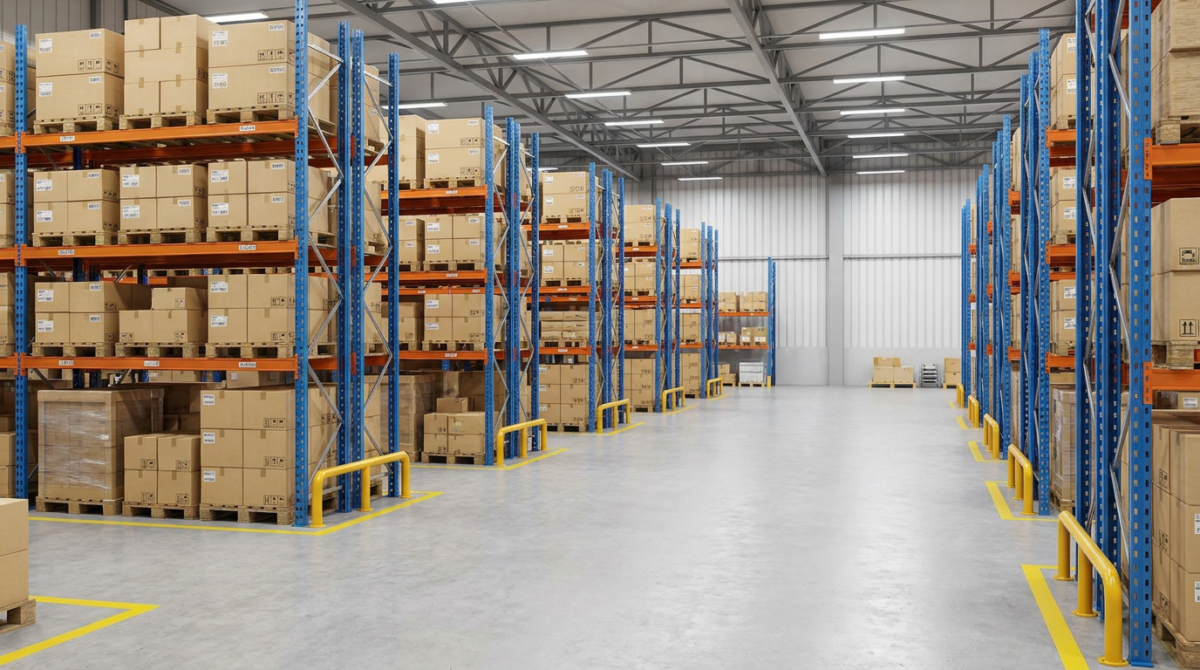
The Complete Guide to Improving Warehouse Safety Culture and Reducing On-Site Accidents
A disorganized warehouse floor is not just a nightmare from an operational point of view, it’s an injury that’s waiting to happen. The relationship between warehouse disorganization and accidents is direct, quantifiable, and mostly avoidable. This article covers system-level adjustments that shift warehouse safety culture from reactive obedience to something that simply operates regularly.
Why Organisation Is A Safety System, Not A Housekeeping Task
Most existing safety programs are behavior-focused: wear your PPE, follow the procedure, attend the toolbox talk. That’s not without merit but it overlooks something more basic still. When the environment itself is untidy, cluttered, and generally disorganized, it creates cognitive friction. Workers negotiating their way through blocked or stray stock, going around a pallet that’s in the wrong bay, or searching for a jack that’s been left in another are not following a behavior but making tiny, coerced, and continuous decisions. And this is what it looks like when things are just about to go wrong.
Body stressing, falls on the same level, and being hit by moving objects add up to 70+% of all serious workers’ compensation claims in warehousing and transport (Safe Work Australia), and all three have a direct relationship with how space is managed. Blocked aisles push detours near forklifts. Misplaced stock is waiting at foot level for you to trip over it. Packaging material on the floor creates a slip condition that steel-toed boots simply can’t compensate for.
Treat spatial organization as a safety input – one that shapes behavior before anyone makes a choice – and you’ll get outcomes that no amount of signage alone can give you.
Applying The 5S Framework To Hazard Elimination
The 5S methodology – Sort, Set in Order, Shine, Standardize, Sustain – was created for manufacturing efficiency, but it can be argued it’s even more valuable when applied to warehouse safety. Each step eliminates a direct source of hazard.
Sort gets rid of everything on the floor that doesn’t have a functional, assigned purpose. Broken pallets, surplus racking, obsolete stock, and expired consumables all use space that people then get used to seeing, allowing potential hazards to become ‘normal’. They simply don’t remember those things are in the way.
Set in Order gives every item, tool, and piece of equipment a designated location. This is where shadow boards prove their operational worth – a pallet jack in a marked bay is a pallet jack not blocking a walkway. The same goes for stretch wrap dispensers, cleaning carts, and hand scanners.
Shine is not about shiny floors. It’s about making a relatively clean floor surface that then shows up fresh spills, new damage, and recently lost items. When the whole floor is already a mess, you can’t tell what’s just been dropped.
Standardize turns steps 1 to 3 into what’s expected. If it’s not written down, every shift manager has their interpretation meaning you have three versions of "tidy" and no consistent measure for an audit.
Sustain is the most difficult and where most programs fail. If you can’t integrate ongoing compliance into your existing routine it won’t get done so make that quick walk through part of the clocking-on process, use peer-to-peer checklists, or any other method that incorporates step 4 into your daily operation.
Segregating People From Machines
Materials handling equipment causes some of the most disabling incidents in warehousing. Forklifts and reach trucks operate in tight spaces, with drivers reliant on mirrors and cameras to see directly behind them, and are often asked to handle loads pushing the machine to its safe weight limit.
In my view, warehousing managers should be looking at ways to ensure that pedestrians and machinery don’t need to share the same floor space, rather than pushing harder on training programs for forklift operators.
For pedestrians and machinery to not cross paths, you need to divide areas with highly visible floor paint to show clearly where the pedestrian zone ends and the forklift thoroughfare begins; install bollards or guardrails to physically prevent pedestrians from crossing too close to key intersections; and place signs warning about forklift traffic at eye level in advance of the change, not 5 ft. past it after walkers have stepped into the path of a reversing truck.
Ideally, managers would also have a formal traffic management plan that specified where vehicles must enter and leave the work area, where workers would cross and machinery had the right-of-way, what the speed limit was in the building, and what areas must be avoided while a forklift is actively engaged in loading.
Building A Near-Miss Culture
The difference between nearly avoiding an incident and having lost time due to an incident is often just a matter of timing. The pallet that shifts triggering a near-miss event will not always right itself during the next attempt to retrieve it. The near-miss incident in the cafeteria may not be noticed by the worker who normally cleans up the area, who works the night shift, and is not as alert at 3 p.m. as are his daytime co-workers.
Near-miss reporting also leads the health of the culture of safety in an organization. Sites with a high rate of near-miss reporting often have a low rate of serious incidents. They’re not luckier; they’re just identifying and addressing the risks before it’s too late. Sites with few near-miss reports and a moderate rate of incidents are not safe; they’re just not reporting.
For near-miss reporting to be effective at identifying potential hazards before there are injuries, the barriers to reporting must be minimal. Eliminate fear of blame and keep the reporting mechanisms simple. If someone believes that reporting a hazard will result in a discussion of their work performance, they won’t report the hazard. If the process is onerous, the person most likely won’t report the hazard. The mechanism should be accessible in two minutes. The reporting employee should observe a response within 24 hours. When people see a response, they respond. No mandate needed.
Pallet Integrity and Racking Safety
A racking collapse is one of the few warehouse incidents that could be classed as catastrophic rather than just serious. The load weights involved, coupled with the height of modern high-bay systems, mean that barely anything goes wrong before it’s too late to do anything about it.
Pallet quality lies at the heart of racking safety. One broken stringer board, a missing deck board, or a pallet inexpertly repaired with inappropriate fasteners can fail under a load which it would otherwise carry, transferring stress directly into the rack upright. The pre-use check before any pallet goes live must look for: visible splits, nail pull-through, liquid damage, and any repair not approved for use. If in doubt, throw it out.
Load limits are never to be exceeded. Have your racking supplier professionally install the maximum allowable load notice for each bay at the aperture to that aisle, so it won’t get lost in a file somewhere. Companies that are sourcing their Pallet Products in Melbourne or elsewhere must demand certified load limits and undergo regular quality control if they are to keep their warehouse safe and orderly. The true cost of a sub-par pallet is only ever seen when it collapses.
Audits on the state of pallet racking should operate on a three-tier system. Daily: a visual walk-past for damage, dislodged clips, or leaning bays. Weekly: an inspection involving all uprights, bracing, and beam connections, with results recorded. Monthly: a formal audit against the manufacturer’s original plans with any bays out of true unloaded, until remedied. The daily check doesn’t need to be long, five minutes per aisle is enough; it just needs to be done.
Ergonomics and Weight Distribution In Vertical Storage
The way items are distributed in racking influences risks of injury and inefficiency. Heavy, frequently accessed items should be stored in the "golden zone" between knee and shoulder height, where they can be lifted without excessive postures and handled without mechanical assisting devices.
Heavy items on the floor require stooping and awkward lifts. Heavy items above shoulder height require overreaching and loss of load control. Both produce musculoskeletal injuries, the costs of which add up over months before eventually prompting a compensation claim, and are easily missed in short-term safety audits.
Light, infrequently picked items go in the higher, out-of-reach positions. This is not just about ergonomics – it minimizes racking loadings in the least structurally efficient locations and concentrates the most frequent handling interactions at the least stressful height.
Visual Management As Behavioral Infrastructure
Visual indicators do something training isn’t capable of replicating: they operate beyond conscious remembrance. An employee who has attended a manual handling session is aware of the requirements but needs to consciously recollect the instructions. A floor marking, a color-coded zone, or a shadow board revealing a space where a tool is kept offers a reminder when and where it’s most needed, at the task site.
Good visual management within a warehouse will use floor markings to identify areas, signage that clearly gives a message without demanding to be read, and coloring systems that are uniform across every location on the site. If one pathway uses yellow to signify danger and another uses it to indicate a pedestrian pathway, it will fail. Repeating the same visual signals is what helps these to become unconscious.
Shadow boards employed for cleaning accessories and small tools do double duty as well. They tell employees where to place objects when they’re done with them, and they quickly indicate when a specific item is missing. A shadow board that’s light at the beginning of a shift is a good hint that an object has gone astray before somebody starts looking for it in the passageway.
Standardising Post-Incident Analysis
The instinct is to take corrective actions at the individual level when an incident occurs; retrain the person, issue a reminder, update the induction. This can treat the symptom but leaves the cause in place for the next person to encounter.
Root cause analysis seeks to identify the conditions that allowed the incident to happen. Poor lighting in a pick aisle isn’t a lighting problem; it’s an inspection process that didn’t flag a failed fitting. A slip near the loading dock isn’t a footwear problem; it’s a housekeeping schedule that doesn’t cover that zone between shifts.
The results of a root-cause analysis need to inform warehouse layout, workflow design, and inspection checklists. This is the virtuous cycle: an incident prompts an investigation, the investigation pinpoints an organisational or environmental factor, and that factor is corrected at the system level so it can’t recur.
Warehouse safety culture isn’t in the induction manual or the annual audit. It’s in the daily condition of the floor, the quality of the materials in use, and whether the people working in the space trust that their observations will be acted on. Get the organisation right, and the behavior tends to follow.
