
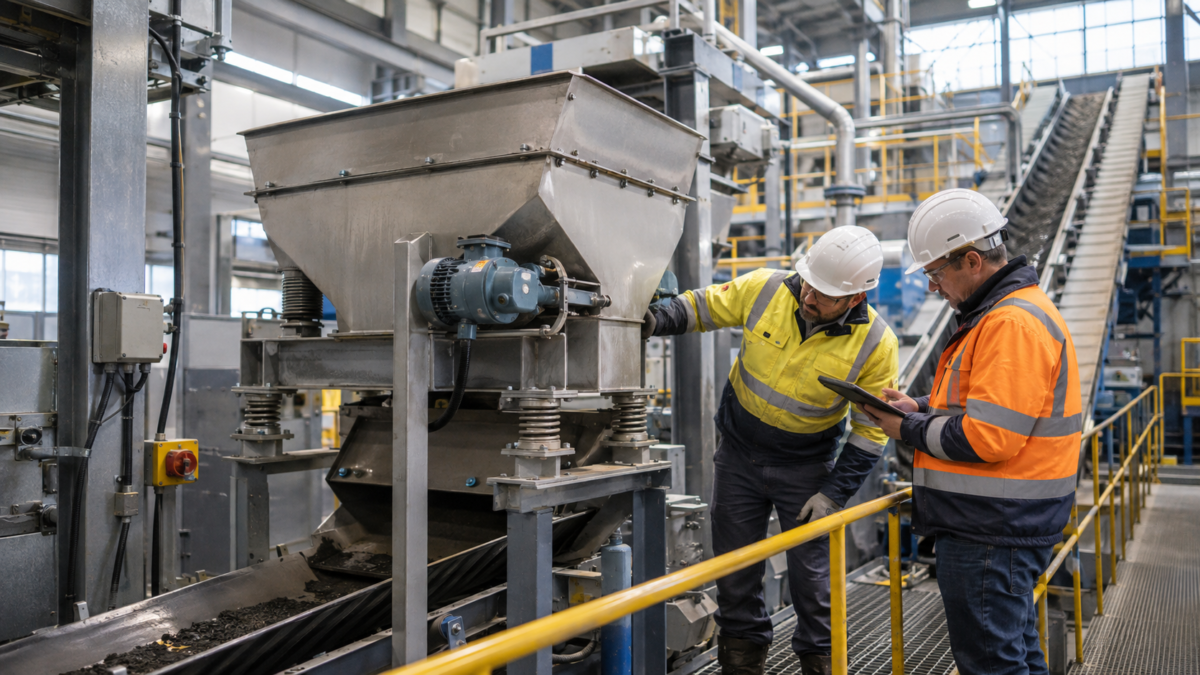
9 Critical Design Considerations for Integrating Vibration into Existing Processing Lines
The addition of a vibrator to a production line initially not so equipped is an exercise in mechanical simplicity. Not so. The majority of the costs associated with these projects arise from unconsidered assumptions made prior to the installation, which reveal themselves in the form of broken brackets, tripped sensors, or a shift-long downtime for an engineer to re-machine a mount.
Calculate force from material, not motor nameplate
Power rating rarely defines performance on a hopper, bin, or chute. It is the centrifugal force of the vibrator that moves material, making flow properties (cohesive strength, moisture content, particle size and density) and bin geometry critical factors in choosing a drive. Cohesive strength, combined with other flow characteristics, will define a flow function of 2 to 3, essentially a multiplier indicating the degree of difficulty inherent in removing material from a bin or hopper. Measured in a test lab, this value can be estimated for a given material by observing how it behaves when piled at an angle (angle of repose), which indicates its cohesiveness (the greater the angle, the more cohesive). The calculated flow function and the geometry of the bin or hopper in question are then used to determine the necessary force for initiating and sustaining flow. Underestimating this figure results in the same flow problem, a constantly overworked vibration drive, and shortened drive life, while overestimation can lead to hopper damage and/or material compaction due to excess force. Once the force requirements are known, a suitable motor vibrator can be selected based on the necessary power rating, one that takes environmental variables into account (dust, washdown, outside temperature) rather than a generic catalog entry that has little basis in reality.
Check the resonance of the structure before mounting
Production lines are generally built to support static loads. Dynamic loads, which are essentially oscillating forces applied to a structure, are rarely a consideration in their design, even though a vibrator is precisely that. If the resonant frequency of the structure being vibrated approaches the operating frequency of the drive being installed, amplification (rather than isolation) of forces occurs, with deleterious consequences on the integrity of welds, fasteners, and other structures some distance away from the drive itself.
A resonance audit of the structure should be performed before the retrofit, not after a crack or separation has occurred. This may involve stiffening the structure in key places (greater thickness of material on brackets, reinforcements, or changes from bolted to welded joints capable of withstanding cyclic loads) to withstand the dynamic load being applied. Resonance is a consideration that, if overlooked or underestimated, can have an enormous impact on the cost of a retrofit project in the later stages of its lifespan. It is no longer a localized problem, and the only solution is to shut down the line while reinforcing the entire mounting structure. Retrofitting a properly sized isolation mount at a later date may well have been a cheaper option.
Verify phase rotation on site, not on paper
Three-phase electric vibrators have a direction of rotation. If the phase rotation is incorrect, the unit will still run, but at reduced force while placing additional stress on the eccentric weights and bearings. This often goes undiscovered until the drive output has been measured and found to be insufficient, or even later, when an unanticipated bearing failure occurs.
It is a simple matter to confirm rotation direction against manufacturer specifications, but this step is often overlooked in retrofit projects that assume the electrician has performed this task correctly. In truth, it is often the responsibility of the person mounting the unit to ensure that the rotation matches the specified direction.
Specify ingress protection and hazardous area classification first
IP (Ingress Protection) ratings and hazardous area classifications are essential specifications that cannot be determined at a later date. The wrong type of enclosure for a washdown environment or a dust-laden environment will inevitably fail prematurely due to the ingress of moisture or particulate matter. If the environment falls under the ATEX classification or another standard governing explosive atmospheres, the wrong type of enclosure could render the retrofit illegal for both mechanical and safety reasons.
In cases where the wrong enclosure was specified, replacing the incorrect standard unit with a certified explosion-proof model will incur higher costs by as much as three to five times the original catalog price. It is not only the cost of the new unit that is increased, but other factors such as re-certification of the retrofit and rewiring add up, as well as possible downtime for the production line. It will undoubtedly affect the maintenance budget and schedule for the system.
Think twice before choosing a VFD
A Variable Frequency Drive (VFD) is an option that may seem appealing, but it is offered far more frequently than it is actually required.
A VFD allows the operator to vary the drive speed, making it useful in cases where the material being handled changes from one production cycle to the next. In theory, this allows the operator to adjust the output force to match the needs of the material in question or to optimize productivity within the limits of the drive’s capabilities. It may also be the only option in cases where a single-speed drive of the necessary force rating is unavailable.
However, VFDs change other characteristics of the drive, some of which may not be obvious to the unprepared purchaser. Driving below the rated frequency reduces the amount of air cooling available to the motor. This means that the drive will need to be de-rated (its torque capability reduced) to avoid overheating at lower speeds, a requirement that is missed entirely if the de-rating factor is not taken into account.
If the material handling characteristics are varied enough to justify the complexity, a VFD is a good choice. If not, a fixed-speed unit is easier to maintain and has one fewer potential point of failure.
Design in isolation to keep the vibrations in one place
The dynamic forces generated by vibratory equipment are transferred to everything connected to it, with the exception of systems that have been isolated using mounts or other isolation features. Load cells and other weighing equipment are especially sensitive to this form of interference, and a unit several meters away without proper isolation can cause measurement errors even when the source of the vibration is unrelated to the scales or sensors.
This is a design consideration that must be addressed during the retrofit planning rather than waiting until commissioning or later. Retrofitting isolation features at a later date involves downtime for the entire vibrating system as well as any connected systems such as weighing equipment. This is especially true if calibration drift occurs as a consequence of vibratory interference, which is a possibility that should be considered during the retrofit planning.
Plan in access to bearings during the retrofit
Vibrator bearings have a finite service life (a characteristic of any bearings subjected to cyclic loads). What distinguishes a well-planned retrofit from a poorly planned one is the opportunity to inspect, grease, and replace bearings without shutting down half the production line in the process. We have encountered several installations in which the vibratory unit had been mounted in a manner that made perfect sense from a structural point of view, but necessitated the removal of an entire conveyor system in order to access the bearing housing for routine maintenance. This represents a serious design flaw that increases downtime for every subsequent maintenance cycle by several orders of magnitude. The maintenance access should have been specified ahead of time, not left until after installation.
Understand the cost of a specification error
The figure that is most useful when discussing the economics of retrofit planning in manufacturing is the loss per hour of downtime for a production line, typically on the order of $260,000. This takes into account the loss of production, downtime wages, and the ripple effects it has on downstream processes. With this figure in mind, it is clear that shaving a few hundred dollars off the budget by specifying an undersized or incorrectly rated vibrator is rarely a good option. The cost of the unit rarely plays a large role in the total cost of the retrofit, and a specification error can add significantly to the costs in several areas. The emergency call-out, downtime for the production line during servicing, retrofitting the mount to the correct specifications, and the opportunity cost of lost production all contribute significantly to the final figure. Finally, the production gains realized by the retrofit (if any) should also be taken into account. If a faster or more efficient vibrator is used, the opportunity for greater production is also increased, either in the form of more product (greater weight per vessel or additional vessels for the same overall weight) or reduced labor costs for similar production figures.
The best retrofit planners incorporate this opportunity cost into their calculations, as a properly planned retrofit can save the client money by reducing energy consumption for the same production output, reducing maintenance costs, reducing downtime, and optimizing production rates. Engineers who have had negative experiences with retrofit projects that failed as a result of improper specification are likely to take this step automatically in future projects. It is much cheaper to do this the right way the first time.
Commission properly before signing off
The considerations mentioned previously are rendered moot if the retrofit is not commissioned correctly. Testing a retrofit under load and measuring the actual force applied to the material is essential in ensuring that the chosen unit is appropriate for the material in question and will perform as needed. This allows the retrofit to be fine-tuned based on real-world operating conditions. Simply commissioning the retrofit and signing off on the project after a successful trial run with “ideal” material only leads to problems later down the line when material problems arise.
Specification errors on vibration equipment are rarely obvious, and it is easy to overlook the details and assume everything will work as intended. The consequences of these errors become obvious long after the retrofit is complete. If a bearing fails prematurely, a bracket cracks, or a weighing system fails due to vibration, the additional costs incurred to diagnose and resolve these issues will be far greater than any savings realized by specifying incorrectly. The considerations mentioned in this article are not merely items on a hardware checklist; they represent the questions that need to be asked to ensure that the retrofit will run smoothly for years to come. The retrofit project that runs quietly for decades after commissioning will not be remembered for the hardware choices that were made.
